

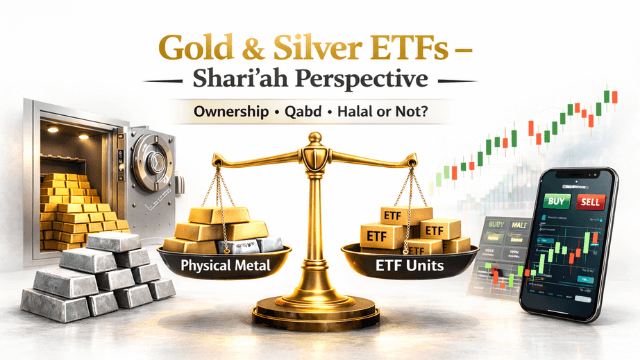

Precious metal investment has shifted from physically holding gold and silver to modern financial instruments such as Gold and Silver ETFs and digital funds. In the past, people usually invested by buying and storing physical coins or bars, but today many investors prefer these modern investment options. However, in Islamic finance, gold and silver are not treated as ordinary commodities. They are classified as ribawi items, which means their buying and selling must follow specific Sharīʿah rules. Because of this, every new investment method related to these metals needs to be carefully examined.
As digital investment products like Exchange-Traded Funds (ETFs) and Fund of Funds (FoF) become common in modern portfolios, Shari’ah-conscious investors naturally want to know whether these instruments are Sharīʿah compliant. This blog provides an analytical overview of how these products work, the regulatory framework behind them, and the key Sharīʿah requirement of valid possession that determines whether investing in them is permissible.
What is an ETF?
An Exchange-Traded Fund (ETF) is an investment vehicle that pools money from investors to buy a specific underlying asset, such as equities, bonds, gold, or silver. Unlike traditional mutual funds, ETFs are listed and traded on stock exchanges, and their units can be bought and sold on the secondary market during trading hours just like company shares. New ETF units are created by large institutional entities called Authorized Participants, who deposit the actual underlying assets with the fund in exchange for ETF units. Retail investors normally trade these units on the exchange for cash, and the underlying assets are not moved in these transactions. The real assets are transferred only during large creation or redemption processes carried out by these institutional participants
Gold and Silver ETFs: Common Mechanism
Gold and Silver ETFs operate under a shared mechanical framework designed to provide
investors with exposure to metal prices without the burden of physical handling.
Price Tracking
These funds are passive instruments. Their primary objective is to mirror the domestic spot
price of physical gold or silver. The value of one unit is usually linked to a specific
denomination, such as 1 gram or 0.01 gram of the metal.
Physical Backing and Custodianship
To ensure value, the fund is required to hold physical bullion. This metal is stored in highly
secure, regulated vaults. A custodian, typically a specialized financial institution, is
appointed to be responsible for the physical safekeeping, insurance, and periodic verification
of the inventory
Creation, Redemption, and Liquidity
The “Creation Unit” mechanism ensures that the ETF price stays aligned with the market
value of the metal. If the ETF price deviates from the spot price, Authorized Participants
Arbitrage the difference by creating or redeeming units in exchange for physical metal. For
the average investor, the exchange provides liquidity, allowing them to exit their position for
cash at any time during market hours.
Gold and Silver Fund of Funds (FoF)
A fund of Funds (FoF) is a mutual fund that acts as a “feeder,” investing in Gold or Silver ETF units instead of buying physical metal directly.
Key Advantage: It offers accessibility, allowing people without a Demat or trading account to invest in gold and silver prices through regular mutual fund platforms.
How it works: It collects money from investors to purchase ETF units. Its value (NAV) is updated daily based on the ETF’s closing price.
Cost: Investors usually pay a slightly higher expense ratio (MF management fees + underlying ETF fees).
SEBI Regulatory Framework
In India, the Securities and Exchange Board of India (SEBI) prescribes strict regulations to protect investors and maintain the integrity of commodity-based funds. To ensure maximum transparency and safety, the following rules have been implemented:
Investment Rule: A Silver ETF must invest at least 95 percent of its net assets in physical silver and silver-related instruments. Similarly, Gold ETFs must allocate a minimum of 95 percent of their assets to physical gold bullion.
Derivatives Limit: To control risk, investments in silver derivatives (such as ETCDs) are capped at 10 percent of the fund’s total value.
Metal Quality Standards: The physical metal must meet global purity standards. For Silver ETFs, the fund must hold standard 30 kg bars with a minimum purity of 99.9 percent. For Gold ETFs, the minimum purity must be 99.5 percent, adhering to London Bullion Market Association (LBMA) standards.
Tracking Error Management: The difference in returns between physical metal and the ETF must not exceed 2% annually.
Shari’ah Perspective
While it is true that many Gold and Silver ETFs are backed by physical metal held in vaults, having physical backing alone is not enough to make the trade Shari’ah-compliant. Due to certain structural flaws in how these ETFs operate, buying and selling them remains impermissible under Islamic law.
The Core Issue: Lack of Possession (Qabd)
In Shari’ah, for a trade involving movable assets (like gold or silver) to be valid, the buyer must establish Possession (Qabd) before they can resell the asset. Without this, the transaction is considered invalid. This is based on the Hadith of the Prophet Muhammad (PBUH):
(صحيح مسلم، جلد3، صفحہ1160، بيروت)
مَنِ ابْتَاعَ طَعَامًا فَلَا يَبِعْهُ حَتَّى يَقْبِضَهُ، قَالَ ابْنُ عَبَّاسٍ وَأَحْسِبُ كُلَّ شَيْءٍ بِمَنْزِلَةِ الطَّعَامِ
According to Islamic principles, for the sale of any movable item to be valid, the item must be clearly defined, deliverable, and the buyer must have full ownership and possession, whether that possession is physical (حقيقي) or constructive (حكمي).
What Constitutes Constructive Possession?
For possession to be legally recognized, تخلية (Takhliya) is required. This means all barriers between the buyer and the asset must be removed. The buyer must have the legal and customary authority to dispose of the asset as an owner, and the risk (ضمان) must transfer entirely to the buyer. If the item is destroyed, the loss must fall on the buyer. (شامی ۷/۵۱)
وأما الثالث وهو شرائط الصحة فخمسة وعشرون منها عامة ومنها خاصة فالعامة لكل بيع… ومعلومية المبيع ومعلومية الثمن بما يرفع المنازعة فلا يصح بيع شاة من هذا القطيع…، والخاصة، … القبض في بيع المشتري المنقول، …. نعم يزاد في شروط المعقود عليه إذا لم يرياه الإشارة إليه أو من كلامهم تفريعًا وتعليلاً أن المراد بمعرفة القدر والوصف ما ينفي الجهالة الفاحشة و ذلك بما يخصص المبيع عن أنظاره
Furthermore, Badai al-Sanai emphasizes that selling a movable item before possession is prohibited because it involves غرر (Gharar) (بدائع الصنائع،کتاب البیوع 5/180).
(ومنها) القبض في بيع المشتري المنقول فلا يصح بيعه قبل القبض؛ لما روي أن النبي صلى الله عليه وسلم «نهى عن بيع ما لم يقبض»، والنهي يوجب فساد المنهي؛ ولأنه بيع فيه غرر الانفساخ بهلاك المعقود عليه
The Problem with ETFs in India
In the context of Gold and Silver ETFs, constructive possession would only be established if a specific gold bar or silver brick is allocated to the buyer, given a unique identification, and the buyer is issued a certificate representing that specific, identifiable asset.
(aaoifi المعايير الشرعية، الرقم الشرعي57، 3/4)
و يتحقق القبض الحكمي بتعيين السبيكة و تمكين المشتري من التصرف بها، أو بقبض شهادة تمثل ملك سبيكة معينة و مميزة عن غيرهابأرقام للسبيكة
Why Indian ETFs fail this test:
Accounting Entry vs. Possession (قبضہ): Without specific allocation and the right to physical delivery of the specific asset bought, the transaction is merely an “accounting entry.” It does not qualify as a Shari’ah-compliant purchase of gold or silver.
Lack of Allocation: Custodians generally hold large bars (e.g., 1 kg gold bricks). They do not allocate specific portions or unique bars to individual retail unit holders.
Delivery Restrictions: Most ETFs do not offer physical delivery for small quantities. Even if a large investor requests delivery, they are not necessarily given the “exact” same gold that was supposedly “theirs” at the time of purchase.
Conclusion
The Islamic view on gold investment remains rooted in the necessity of actual or
constructive possession. While Gold and Silver ETFs provide a highly transparent and
regulated environment under SEBI, the bridge between financial regulation and Shari’ah
requirements are not yet fully crossed.
For the Shari’ah-conscious investors, the presence of physical metal in a vault is only one part of the
requirement. The essential hurdle is the shift from a pooled “accounting entry” to a system of
allocated ownership where the buyer’s rights over a specific piece of metal are clearly
defined and enforceable.
Until the industry evolves to provide unique allocation and delivery mechanisms for retail
units, investors seeking Gold ETF Shariah compliance or a Silver ETF that is halal must
Proceed with caution and seek out structures that strictly fulfill the Shari’ah requirements of possession, whether physical (Qabd Haqiqi) or constructive (Qabd Hukmi).